


The “27 Club” is a dark piece of music mythology. An unusual number of innovative and groundbreaking artists died at the age of 27. It’s partly coincidence, partly cultural fascination, and always heartbreaking. While the term came into popular use in the 1970s, the originator of the “club” was a Mississippi bluesman with a mysterious, ghostlike presence, haunting music about being chased by hellhounds, and who was one of Rock n Roll’s biggest influences.
We’ve compiled a rundown of the major artists associated with the 27 Club, starting with the man who unintentionally set the pattern.
Robert Johnson (Died 1938)
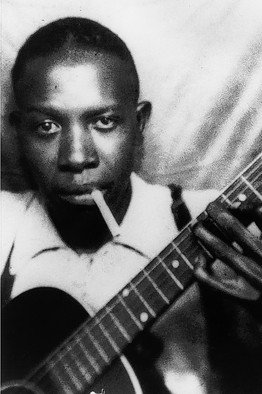
The origin of the 27 Club myth. Robert Johnson, the delta blues guitarist extraordinaire, died at 27 under murky circumstances. The consensus is it was likely poison, though official causes and records were completely absent (much like the rest of Johnson’s life). In his short time, Johnson recorded just 29 songs that we know about, plus alternate takes totaling only 42 tracks.
Interestingly, people really didn’t know Johnson’s music until Columbia released King of the Delta Blues Singers in 1961 (23 years after Johnson’s death). After, his small catalog of recordings was a massive influence on American music, and heavily influenced rock icons from the Rolling Stones to Eric Clapton. Because his death came decades before the “club” existed, his slow-burning influence was so huge, and his life a complete mystery, he’s seen today as the eerie beginning of the pattern.
Brian Jones (Died 1969)
A founding member of The Rolling Stones, Jones pioneered the group’s early sound with his multi-instrumental brilliance. After increasing tension with the band and substance issues, he was booted from the band and died shortly after… found in the swimming pool at his home. Mystery swirled around the circumstances of his passing, and his death was the first in a tragic run of late-1960s losses that drew attention to the “27” pattern.
Jimi Hendrix (Died 1970)
One of the most revolutionary guitarists in history. Hendrix died in London at 27, also under hotly contested and mysterious circumstances. The circumstances, changing stories, coroner report, etc. around Hendrix’s death could be a story or a book itself. But the result remains: the guitarist’s astonishing rise & sudden loss cemented the idea that 27 was a haunting age for artists at the peak of their powers.
Janis Joplin (Died 1970)
Just sixteen days after Hendrix, Janis Joplin died at 27 in Los Angeles. The most common explanation was an accidental heroin overdose, though the circumstances of her death is also the cause of some controversy. But with her album Pearl on the cusp of release, her legendary status was already cementing thanks to her vocais, wild emotional intensity, and huge stage presence. Her death, especially so close to Jimi’s, added to the forboding sense that something tragic was unfolding among the era’s brightest musicians.
Janis Joplin Trivia, Articles, Bands & Bio
Jim Morrison (Died 1971)
The Doors frontman died in Paris at 27, officially of heart failure, though the exact circumstances remain unclear because no autopsy was performed. Mystery surrounding death seems to be a common thread of the club. It was yet another massive blow to popular music at the time. Morrison’s literary ambitions, charisma & turbulent life made him one of the most romanticized members of the 27 Club.
Ron “Pigpen” McKernan (Died 1973)
A founding member of the Grateful Dead, Pigpen was the band’s original blues anchor. He chose not to be part of the psychedelic movement the others embraced; his style came straight from the Muddy Waters and Jimmy Reed records he grew up with. His health declined from alcohol-related issues, forcing him to step back in the early 1970s. He died in 1973 at age 27, making him one of the more quietly significant members of the 27 Club.
Kurt Cobain (Died 1994)
Kurt Cobain, the voice of Nirvana and the central figure of the grunge movement, died at 27 in Seattle in 1994. Cobain struggled with chronic pain, addiction, and the pressure of sudden fame, all of which weighed heavily on him in his final years. The official cause and many signs point to suicide, but again the circumstances of his death continue to be hotly contested. But the Nirvana frontman’s death at twenty seven revived the “27 Club” in public consciousness. Cobain himself had mentioned the age in interviews, adding fuel to the myth. His death reshaped an entire generation’s sense of loss & lamentation on the cost of fame.
Amy Winehouse (Died 2011)

Winehouse’s death from alcohol poisoning at 27 became one of the most discussed modern entries in the 27 Club. Her immense talent, struggles with addiction, and deeply personal songwriting drew comparisons to the tragedies of Joplin and others decades earlier. Influenced heavily by by jazz, soul, and R&B, her album Back to Black proved that deeply retro, jazz-inflected music could dominate the charts, changing the pop game. Her death added a modern and incredibly heartbreaking chapter to the 27 Club, cutting short a career that was already uplifting popular music.
Other Musicians Often Included
Many other artists are frequently associated with the 27 Club due to their influence & circumstances:
- Dave Alexander – Bassist for The Stooges (Died 1975)
- Pete de Freitas – Echo & the Bunnymen drummer (Died 1989)
- Mia Zapata – The Gits vocalist (Died 1993)
- Richey Edwards – Manic Street Preachers (disappeared in 1995, legally declared dead later)
- Kristen Pfaff – Bassist for Hole (Died 1994)
- Alan “Blind Owl” Wilson – Canned Heat singer/multi-instrumentalist (Died 1970)
- D. Boon – Minutemen guitarist (Died 1985)
Why the 27 Club Endures
27 is both young & symbolically tragic. It’s an age where many artists are still rising, not fading. Statistically, there’s no evidence that musicians die at 27 more than at other ages. But culturally, the artists involved were so influential and their deaths so sudden that it has endured in the public consciousness.
Browse the collection. Wear the legacy.
-
 Hot
HotCheech and Chong Los Cochinos T-Shirt – Classic Heavy Cotton
Price range: $34.97 through $39.97 This product has multiple variants. The options may be chosen on the product page -
 Hot
HotCheech and Chong Los Cochinos T-Shirt – Lightweight Vintage Style
Price range: $34.97 through $38.97 This product has multiple variants. The options may be chosen on the product page -
 Hot
HotJimi Hendrix SMASH HITS Album Cover T-Shirt – Classic Heavy Cotton
Price range: $34.97 through $39.97 This product has multiple variants. The options may be chosen on the product page -
 Hot
HotSaint Louis Arch Architecture Baseball T-Shirt
Price range: $37.97 through $39.97 This product has multiple variants. The options may be chosen on the product page