


Syd was Pink Floyd’s original frontman, guitarist, and primary songwriter. In the mid-1960s, he gave the band its name (inspired by bluesmen Pink Anderson and Floyd Council), and its earliest sound.
At Bluescentric, we’re humbled to dream up and produce official Pink Floyd and Syd Barrett T-Shirts and merch on behalf of the band and Barrett’s estate. Naturally, we get a lot of questions, and still hear a lot of rumors about Syd.
So we wrote this article to give you a quick overview of Syd Barrett’s life, his place in Pink Floyd, and what happened to him after his departure from the band.
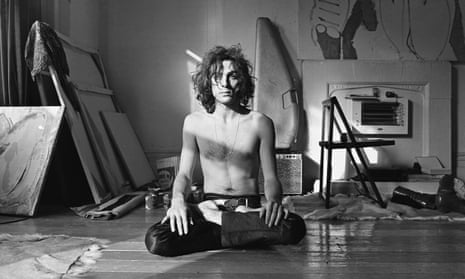
Syd’s Early Life
Syd was born Roger Keith Barrett on January 6, 1946, in Cambridge, England. He grew up in a middle-class family that strongly encouraged his artistic pursuits. As a kid, Syd learned several instruments like piano, ukulele and banjo before picking up the guitar at 14.
Syd and future Pink Floyd co-founder Roger Waters were childhood friends, and attended school together. In fact, Roger’s mother was once a teacher of Syd’s.
Syd met later Pink Floyd member David Gilmour while both were studying at the Cambridge College of Arts and Technology in 1962. They bonded over a love of music, attended concerts and busked together on the streets of London.
Syd Joins What Will Become Pink Floyd
Roger Waters was studying architecture at Regent Street Polytechnic, and formed a small band with classmates and future Floyd members Nick Mason on drums and keyboardist Richard Wright. Syd moved to London in 1964 to study painting at the Camberwell College of Arts and joined the band.

Syd wrote great songs.
So he became the primary songwriter. To put it in perspective, in The Piper at the Gates of Dawn, Syd wrote 8 of the 11 songs himself, and had co-writer credit on 2 of the other three.
Syd loved the music scene, and was particularly influenced by a curious blend of blues music, poetry and children’s stories and rhymes. A careful listen can hear Bo Diddley’s influence in Syd’s rhythms. The result was a strange but endearing avant-garde style full of whimsical imagery and improvisation.
Pink Floyd’s first two singles “Arnold Layne” and “See Emily Play” were written by Syd. He was even the painter of the childlike “See Emily Play” train featured on the album aartwork.
One of the band’s earliest gigs was opening for a new club called the UFO Club, a short-lived psychedelic experiment that shined too brightly and burnt out too fast. But Floyd became the house band almost immediately and developed a dedicated following for their interesting new experimental music and their flashy psyched out synchronized light show.

The band was gaining acclaim; they were getting festival spots, and had a massive U.S. tour coming in the fall. But by the Summer of ’67, Syd began a months’ long descent from psychedelic rock’s poster boy to complete recluse.
Barrett’s Mental Decline
Much speculation has been made about the reason for Syd Barrett’s behavior, from mad poet and acid overloads to schizophrenia. But it’s all still speculation.
In truth, Syd isn’t well understood, and he seemed to be comfortable with that.
But there was one moment that friends and those close to him pointed at as a turning point in his personality.
Syd reportedly went missing for a long weekend and, according to several friends, including Richard Wright, came back “a completely different person”. In truth, it probably was more a collective of moment where one was too far over the line. But perhaps among Syd’s most unsettling characteristics was the more frequent adoption of a dead-eyed stare…
In any case, his mental health continued to decline, until he became a liability to the band.
They had to cancel big dates due to Syd. On their first U.S. tour, during a huge opportunity performing on American Bandstand, Syd infamously refused to lip sync with the rest of the band, and when asked questions by the host, stared blankly off into the distance. It wasn’t even the only time he did that on the tour. He’d forget his instruments, detune his guitar, play a single chord the whole show…
His behavior became increasingly unpredictable until they reached out to his friend David Gilmour to join in support of Syd, but nothing could stop the enigmatic founder’s slow slide to wherever he was going.
And so, about January 26, 1968, the band was going to a show, and simply declined to pick him up. And then again the next show…
Barrett Departs Pink Floyd
It was a rather simple, passive ordeal, and Syd did not seem to have complaints. Finally in April 1968, the band formally announced Syd’s departure. And like that, the band floated away from their dear friend, former creative force, and the person who gave them their name.
“After all, Syd was a living legend… People were very down on us after Syd left. Everyone thought Syd was all the group had, and dismissed us. They were hard times.”
– David Gilmour
Syd was famously reclusive, and effectively nearly never discussed departing the band, so we don’t really know his thoughts on Pink Floyd or leaving it.
We do know that his departure wasn’t an explosive or dramatic moment.
In the several years that followed, Barrett made a chaotic and disjointed attempt at a solo career that did produce a pair of albums. In fact, Gilmour and Waters helped Syd release his first solo album, 1970s “The Madcap Laughs“.
It’s good. It’s very Syd, if you’re into early Floyd. But also strange. And documents some personality quirks that people have argued schizophrenia vs or simply artistic expression. But art is for the interpreter, and both arguments are reasonable.
But by all accounts Syd made it extremely difficult to produce the album. He went through five producers and Gilmour and Waters had to step in at the end to push it across the finish line.
The band obviously still cared deeply for Syd, but respected his privacy. In 1970 Richard Wright played piano on his second solo album, “Barrett“.
In 1972, Syd briefly joined another band, Stars, but it was reportedly quickly a disaster, and Barrett walked off stage mid-set, never performing again.
Two years later his former manager coaxed him into Abbey Road Studios for what would be his final recording session. It was, again, a disaster, which produced no usable recordings.
Syd Disappears and Pink Floyd Ascends

And with that, Syd began to fade into a reclusive obscurity, spending years living in a hotel room from the royalties of Piper. There is much speculation in this period, but hard facts are few and far between.
In the following years, the band’s star continued to rise to almost unheard of new heights.
They released Atom Heart Mother in ’70, Meddle in ’71, then the magnum opus, Dark Side of the Moon in 1973, which stayed on the charts for about fourteen years.
Pink Floyd had become one of the most successful bands in history.
Syd’s absence had for years created both a void and a tension and by 1975, David Gilmour, Roger Waters, and Richard Wright wrote a song about him, “Shine On You Crazy Diamond”, that was obviously therapeutic for the band.
It was to be on their upcoming album, Wish You Were Here.
At this point, not one member of the band had seen their friend in years.
Then, while in the studio recording their song about Syd, one of the strangest twists of fate in rock history touched the band.
Now there’s a look in your eyes
like black holes in the sky
Shine on you crazy diamond
A Ghost Sighting
In the exact moment they were recording “Shine On You Crazy Diamond”, Barrett, whom none of the band had seen or heard from in years, simply wandered into the studio unannounced. Waters said he mistook him for a vagrant at first, and didn’t even recognize Syd. He’d gained significant weight and shaved his head and eyebrows.
When they played Syd the song about him, he did not seem to recognize its significance to himself, nor was he particularly touched by it. In fact, according to Waters and Mason, Syd simply commented “it sounds a bit odd.”
Gilmour said Barrett stayed around for a couple of days, and then when they were having a little celebration for David’s wedding somewhere in the studio, Syd just quietly slipped away without so much as a word.

The band would never see Syd Barrett again.
Except, perhaps, that one time Roger Waters crossed paths in a clothing store and a surprised Syd quickly “shuffled away”…
The members of Pink Floyd had put so much energy into coming to terms with the feeling of Syd’s absence, which manifested into art… and then in a prodigal moment he just appeared in the flesh.
But here or not, Syd was not the himself that they knew.
It was a deeply unsettling experience for the band members.
“I cried. Roger cried. We all cried. It was very upsetting.”
– Rick Wright
Syd Fades Away
Syd stayed around London for several years, but little is known about his movements or interactions. He lived in an apartment complex called Chelsea Cloisters for a period.
Then in 1982, Barrett reportedly left all of his belongings in London and maybe hitchhiked a bit, but mostly walked fifty miles to his mother’s house at 101 St. Margaret’s Road, in Cambridge, and he never left.
From that moment on, Syd lived a reclusive life far away from the spotlight. He kept to himself, and disliked being called “Syd”, preferring his birth name, Roger. He painted and gardened.
In 2006, Barrett died from pancreatic cancer.
The Legend of Syd Barrett Grows
In 2013, a documentary was made about Syd called “Have You Got It Yet? The Story of Syd Barrett and Pink Floyd”, which was co-directed by longtime Pink Floyd collaborator and creator of Floyd’s most famed album art, Storm Thurgood. They make a painstaking effort to track down the diaspora of people who knew Syd, and could help establish some sense of who he was, what he did, and dispel some of the more salacious rumors.
It is quite worth a watch for those interested! The link is below.
Check out our page featuring Pink Floyd Trivia, Articles, Bands & Bio
Watch Have You Got It Yet? The Story or Syd Barrett and Pink Floyd
Browse the collection. Wear the legacy.
-
 Hot
HotCheech and Chong Los Cochinos T-Shirt – Classic Heavy Cotton
Price range: $34.97 through $39.97 This product has multiple variants. The options may be chosen on the product page -
 Hot
HotCheech and Chong Los Cochinos T-Shirt – Lightweight Vintage Style
Price range: $34.97 through $38.97 This product has multiple variants. The options may be chosen on the product page -
 Hot
HotJimi Hendrix SMASH HITS Album Cover T-Shirt – Classic Heavy Cotton
Price range: $34.97 through $39.97 This product has multiple variants. The options may be chosen on the product page -
 Hot
HotSaint Louis Arch Architecture Baseball T-Shirt
Price range: $37.97 through $39.97 This product has multiple variants. The options may be chosen on the product page